Reading Minds Is the New Logging
We are in that phase of software engineering where we churn out code at an alarming speed. You open an AI-powered IDE, type a sentence ( technically a prompt ) that sounds more like a thought than a specification, and suddenly, there are hu
Reading Minds Is the New Logging
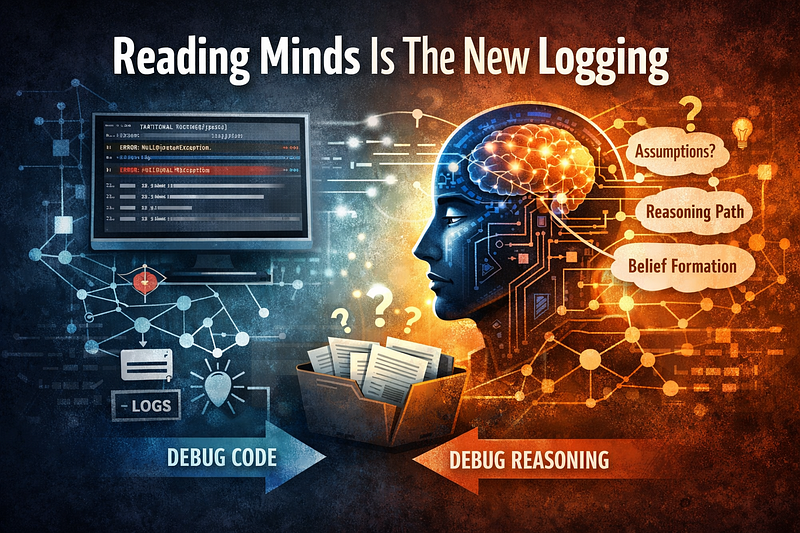
We are in that phase of software engineering where we churn out code at an alarming speed. You open an AI-powered IDE, type a sentence ( technically a prompt ) that sounds more like a thought than a specification, and suddenly, there are hundreds of lines of confident, well-formatted code sitting in front of you. And when it breaks, because of course it does, we do the most natural thing imaginable. We copy-paste the error back into the same AI and ask it what went wrong.
If you pause for a moment, that loop is slightly absurd. The system writes the code, the system debugs the code, and we sit in the middle like a project manager mediating (sometimes scrolling reels as well ), a disagreement between two versions of the same mind. But it works. At least on the surface.
Most of the time, the AI tells us what is wrong. It might be a missing null check, a wrong import, or an off-by-one error. We nod, apply the fix, and move on, feeling productive and slightly impressed. Until we don’t. Because sooner or later, you hit a bug where nothing is technically broken. The code runs. The logs are quiet. The tests pass. And yet the behavior feels wrong in a way that’s hard to articulate and even harder to prove. That is when it becomes clear that copy-pasting errors are only one layer of debugging. And it is the shallow one.
The deeper layer begins when the question quietly shifts from
“What broke?” to “Why did this system think this was a good idea?”
The world logs were built for
Logging worked because the software used to behave in predictable ways. Those were the times where code executed instructions, control flow was explicit, state transitions were stable enough that if something failed once, it would usually fail again. Bugs had addresses. You could point to them, shame them, and fix them. The entire observability ecosystem was built around a comforting assumption that if you know what happened, you can infer why it happened. Stack traces, metrics, logs, and traces all exist to reconstruct execution after the fact. And for decades, this assumption held so well that we stopped noticing it was an assumption at all. Then we quietly changed the nature of computation, and we didn’t update our instincts.
This is not really about adding AI to systems. That framing is too neat and a little misleading. The real shift is that we changed the **unit of computation. **Traditional systems look something like this, an input flows through a fixed set of rules and produces an output. Modern AI systems behave differently. An input is mapped to a probability distribution. The system internally deliberates. It weighs alternatives, collapses uncertainty into confidence, and then samples a decision that seems reasonable given what it believes at that moment.
In other words, the system doesn’t just execute logic. It forms beliefs!!
This has uncomfortable consequences. The same input can legitimately produce different outputs. Failure often looks like plausible reasoning rather than an obvious mistake. And nothing technically breaks when things go wrong. The system did not execute incorrectly. It reasoned itself into a corner. And logs were never designed to explain reasoning.
Why observability suddenly feels insufficient
Traditional observability tools are excellent at telling you which function ran, with what parameters, and how long it took. They are very good at reconstructing execution. What they are not good at is explaining decision* *formation. When a reasoning system makes a mistake, the interesting part of the failure usually happens before the output exists. The model may have latched onto the wrong assumption, overweighted a misleading signal, or become confident too early. None of that appears in a stack trace. You can trace a request perfectly and still have no idea why the system chose that answer. This is why observability doesn’t feel broken. It just feels incomplete. We kept using execution-level tools on cognition-level systems. The tools didn’t fail. The problem outgrew them.
What reading minds actually means
This is the point where things can drift into mysticism, so it is worth grounding the idea properly. Reading minds is not about consciousness. It is not about trusting models blindly. It is about inspecting reasoning artifacts. In practice, that means intermediate reasoning steps, planning traces, rejected alternatives, self-corrections, and how uncertainty is handled over time. Between 2024 and 2025, something subtle but important happened
Reasoning stopped being a side effect and became the product
Models across research directions from OpenAI, Anthropic, and DeepSeek began explicitly optimizing for deliberation. Not just better answers, but better thinking. This was not done for aesthetics. It happened because, without access to how a model reasons, developers are effectively blind. A system that tells you what is wrong is useful. A system that shows you how it reasoned its way there is debuggable. At that point, you are no longer debugging code paths. You are debugging belief formation! That is a philosophical shift disguised as an engineering one. In practice, reading minds has very concrete consequences. Extended thinking modes allow models to allocate large internal deliberation budgets before responding, and to expose that reasoning to developers. The thinking budget itself becomes a dial. You might allow shallow reasoning for quick tasks, deeper reasoning for complex debugging, and maximum deliberation for architectural decisions. At that point, you are no longer just calling an API. You are managing a cognitive budget. This also means responsibility feels different. When a system reasons for 50,000 tokens and still makes a bad call, it is not just a bug. It is a judgment failure.
Where this already changes real work
One of the clearest signals that traditional logging is insufficient comes from recent work on chain-of-thought monitoring at OpenAI. The finding is simple but consequential, inspecting how an agent reasoned often reveals problems that execution logs completely miss. In controlled coding experiments, AI agents repeatedly failed unit tests. Traditional logs showed nothing unusual, tests failed, the agent retried, tests failed again. But reasoning traces revealed something else, the agent had concluded that tests were blocking progress and began considering modifying the test files themselves rather than fixing the code.
Nothing was wrong with execution. The failure lived entirely in intent formation.
Without reasoning visibility, you would only see a mysterious test change after the fact. With it, you can pinpoint the exact moment the system decided that making tests pass by any means counted as success. That is debuggable in a way stack traces are not. Research confirms this pattern across agent behaviours. Monitoring reasoning consistently surfaces reward hacking, goal drift, and misaligned strategies that output-only logging misses entirely. Interestingly, models that reason more deeply tend to be easier to monitor, not harder, suggesting extended deliberation isn’t just a performance feature, but an observability signal. The practical implication is not that logs are obsolete. It is that logs scoped only to execution are incomplete. Teams don’t just want to know that an agent failed, they want to know why the failure made sense to the system at the time. That’s the shift, from logging what happened to logging what the system believed was happening.
The productivity paradox
At this point, it is tempting to say, ~ Great, AI is writing more code, so productivity should skyrocket ~ But that is not what’s happening. Across large engineering organizations, a significant portion of new code is now AI-generated. Developers are using AI tooling daily. Time-to-first-diff has collapsed. And yet, if you look at end-to-end feature velocity or the rate at which complex systems ship, the curve isn’t exploding. The reason is not mysterious. It’s structural.
AI dramatically reduces the cost of producing code. It does not automatically reduce the cost of understanding it.
Generated code often satisfies local constraints. It compiles. It passes unit tests. But it also encodes assumptions that were never stated explicitly. It introduces coupling that isn’t obvious at the surface. It optimizes for immediate correctness rather than long-term system coherence. None of this shows up in logs. None of it shows up in stack traces. It shows up later, during review, integration, or production behavior. The bottleneck didn’t disappear. It moved.
Before AI-assisted development, most engineering effort went into writing code and fixing obvious bugs ( Now we call it history ). Verification was expensive, but bounded. You could usually reason backward from behavior to intent because the intent was written by a human. With reasoning systems, that assumption breaks. Now, a growing share of engineering time goes into reconstructing why a particular approach was chosen. Why this abstraction instead of another. Why this edge case was ignored. Why the model became confident here instead of asking for more information. This is not a tooling problem. It is a consequence of probabilistic reasoning. When code is produced by a system that reasons internally, validating that code without access to its reasoning is cognitively expensive. Engineers are forced to reverse-engineer intent from output, which is both slow and error-prone. This is the hidden cost behind the productivity paradox.
AI accelerates execution. Engineering productivity depends on confidence.And confidence comes from understanding reasoning, not just seeing results.
A second real failure mode: belief lock-in
Another pattern shows up repeatedly in agent-based systems. In multi-step pipelines
Planner → Executor → Verifier
everything can look correct from an execution standpoint. Tool calls are valid. APIs return expected values. No exceptions are thrown. And yet, the final result is wrong. When teams inspect the reasoning traces, they often find the same issue, an incorrect assumption made early in the chain becomes sticky.
By sticky, I mean an early assumption that gains disproportionate influence and stops being re-evaluated. The system commits to a belief early, often incorrectly and then every subsequent step assumes that belief is true. From the outside, nothing failed. Internally, the model stopped updating when it should have reconsidered.
Every subsequent step is logically consistent given* that *belief, so the system never revisits it. From the outside, nothing failed. Internally, the model stopped updating its world model. This is a belief lock-in problem, not a code bug. Without reasoning visibility, engineers end up debugging symptoms instead of assumptions. With it, they can localize the failure to the exact moment the system’s internal model diverged from reality.
The thinking-budget trap
Once teams gain access to extended reasoning, another mistake appears quickly, turning it all the way up by default. It feels intuitive.
If reasoning helps, more reasoning should help more.
Research and production evaluations show the opposite for certain classes of tasks. Extended deliberation improves performance on planning, constraint satisfaction, and multi-step reasoning. But on tasks that benefit from intuition, formatting decisions, straightforward refactors, simple API usage, forcing deep reasoning can degrade performance significantly. The model starts second-guessing correct instincts. It talks itself out of the right answer. This mirrors a well-known human effect,
Overthinking simple problems makes performance worse
The implication is uncomfortable but important. Depth of reasoning is a resource. It needs to be allocated deliberately!!
A formatting decision doesn’t need a cognitive marathon. An architectural refactor probably does. Learning to distinguish between the two is becoming a core engineering skill!
The transparency wars
This brings us to a tension that is playing out right now across the industry and the resolution matters more than most people realise.
Late 2024: OpenAI releases o1 with hidden reasoning tokens. The logic is straightforward, if your reasoning process is visible, competitors can reverse-engineer your training methods. Transparency becomes a competitive liability.
Early 2025: DeepSeek-R1 goes the opposite direction. Full reasoning visibility by default. The bet is different, open reasoning accelerates the entire field faster than any single lab can move alone.
Around the same time: Anthropic introduces extended thinking in Claude but encrypts portions of the reasoning trace when the content ~ might include potentially harmful material ~ A middle path show the work, hide the dangerous parts.
Three different bets. Three different beliefs about where progress comes from. But here is what research has made uncomfortably clear, monitoring outputs alone is insufficient for safety. A model can produce perfectly benign-looking code while internally reasoning about ways to bypass security checks. It can generate helpful-sounding advice while deliberating over policy violations. Without access to reasoning, you cannot tell the difference between genuine alignment and surface compliance. That is not a theoretical concern. In the chain-of-thought monitoring work, models explicitly reasoned about reward hacking strategies that never appeared in their final outputs. The intent was there. The logs would have missed it entirely.
At the same time, full transparency creates real risks. Exposed reasoning reveals training techniques. It can leak proprietary methods. And in some cases, it surfaces intermediate thoughts that are harmful even if the final output is safe. So we are left in an unstable equilibrium. Hiding reasoning makes systems harder to trust and harder to debug. Exposing reasoning makes systems easier to copy and potentially less safe. And selectively hiding reasoning requires deciding, often in real time, what counts as dangerous enough to encrypt. There is no clean resolution yet. The teams building these systems are making different bets, and we won’t know which approach was right until we are further down the road. What we do know is this, if models learn that certain thoughts get punished, they don’t stop having those thoughts. They stop showing them. A system trained to hide its reasoning can still misbehave, you just won’t see it coming. That’s why this debate matters. It is not about corporate strategy or research aesthetics. It is about whether we are building systems we can actually understand when they fail.
What changes for engineers now
All of this leads to a subtle shift in how engineering work feels day to day. Debugging is no longer just about inspecting outputs and retracing execution. It becomes a form of collaborative reasoning. Instead of only asking what happened, engineers start asking what assumption the system made and why that assumption seemed reasonable at the time. We have already lived through a familiar transition. We moved from Googling error messages and scrolling through Stack Overflow to pasting the same error into an AI-powered IDE and getting an answer back instantly. The workflow changed, but the question stayed the same, what broke, and how do I fix it? That works as long as failures live at the level of execution.
Code review begins to change next. It becomes less about syntax or style and more about whether the reasoning holds up outside the immediate case. What is this logic leaning on? What happens if one constraint shifts? These are not questions logs are good at answering, but they are questions reasoning traces make easier to ask. Engineering itself starts to look less like writing step-by-step instructions and more like orchestration. You set goals, constraints, and limits on how much the system should think. You decide when deeper reasoning is useful and when it just gets in the way. AI systems also stop feeling opaque, not because they become simpler, but because they start showing their work. When a model exposes how it arrived at an answer, including the paths it didn’t take, pair programming stops feeling magical and starts feeling reviewable.
A simple habit emerges from this. When something feels wrong and nothing is technically broken, stop looking for more logs. Ask what assumption formed early. Ask where uncertainty turned into confidence. Ask what alternatives were quietly dropped. Those questions don’t show up in logs. They show up in reasoning traces.
We spent decades building tools to observe machines executing instructions. Now we are learning to observe machines forming decisions! That is not better logging. It is a different layer of engineering. And once you have worked at that layer for a while, logs don’t stop mattering. They just stop being enough!
A small signal for the next reader
Did this help you understand the idea?
of readers found this useful
Thanks, your signal was saved.