The Physics of Prompting: Why Words Don’t Matter, But Structure Does
For the past few months, I’ve basically been living inside this sacred AI vibing + building multi agent systems + prompting zone. You know that phase where your YouTube is full of ‘how to prompt better’ videos, your tabs are full of blog po
The Physics of Prompting: Why Words Don’t Matter, But Structure Does
For the past few months, I’ve basically been living inside this sacred AI vibing + building multi agent systems + prompting zone. You know that phase where your YouTube is full of ‘how to prompt better’ videos, your tabs are full of blog posts, and you’re suddenly convinced prompt engineering is 50% magic and 50% trauma?
That’s me.
Some days I’m learning. Other days I’m vibe-coding. And nowadays it has become the new normal, not COVID normal, but AI normal. Just before this AI wave got too intense, people used to forward WhatsApp messages like it was their life’s purpose. But now? People are generating content on their device with ChatGPT and forwarding that. Everyone are feeling excited with the power they in their hands. Meanwhile I’m here, actually building multi-agent systems, trying to put guardrails, playing tug-of-war with prompts and wondering why the model behaves like it’s having one of those ‘what day is it again?’ brain-fade moments instead of acting like a deterministic system.
And the wild part? I’ve actually developed patience from all this, massive noticeable patience ( I swear prompting is cheaper than therapy )
Every time I hit a roadblock and asked someone for help, I got a different recommendation
- Try meta-prompting
- Try one-shot
- Try few-shot
- Try many-shot
- Try asking it politely
- Try scolding it a bit
Every day a new type of prompting would drop, like a never-ending Swiggy menu for LLMs. And somewhere between all these styles, it finally hit me one day
Prompting is not communication, its a relationship problem. These models never follow English. It follows gradients. It responds to whichever tokens trigger the right neuron networks, and sometimes that has nothing to do with what I meant, only what I typed at the wrong spot
The Unexpected Realisation
At some point, after all the prompting experiments and chaos, I caught myself doing something weird. I wasn’t rewriting instructions, I was rearranging tokens. Moving one word up, moving another line down, removing noise and adding structure. And suddenly the model would behave, Not because I “explained it better.” But because I placed the right tokens in the right slots.
That’s when the realisation landed, not softly, but like a debugger hitting a breakpoint
LLMs don’t follow meaning. LLMs follow mechanics.
They react to:
- Placement (position bias)
- Density (entropy control)
- Patterns (in-context learning)
- Identities (neuron activation)
- Structure (attention routing)
The harsh truth is this
You can write the clearest English in the world, and the model will still misfire if the structure doesn’t activate the right pathways.
Prompting isn’t about telling the model what to do. It’s about shaping the environment it thinks inside.
Once I saw this, everything started making sense. All those random successes, those bizarre misfires, they weren’t random at all.
There’s a pattern -> There’s structure -> There’s physics
The deeper I went, the more I realised prompting isn’t a language problem, it is a mechanics problem. Every successful prompt was basically me unknowingly manipulating math, attention weights, positional encodings, and tiny probability shifts. I was not writing better instructions, I was accidentally hacking the physics of how the model thinks.
The Hidden Physics of Prompting
Before I understood the physics, I was just copying random styles I saw online, think step by step,** giving examples,** shouting constraints in ALL CAPS. Some worked, some didn’t, and I had no idea why. Then I realized there are no types of prompts. There are only five forces, attention routing, entropy control, pattern priming, identity activation, and attention sinks. Once you understand which force you’re manipulating, prompting stops being magic.
The deeper I went into prompting, the more I realised I wasn’t giving instructions, I was manipulating a physical system built out of math, geometry, and probability. Once you see the internals, the whole thing makes sense. I have tried to break down the forces that secretly dictate how every LLM responds.
1. Attention Routing : The Gravity of Early Tokens
**Attention routing **= which parts of your prompt the model looks at when generating each word.
I had written a prompt that was perfect on paper, detailed instructions, clear constraints. And it failed. Repeatedly. Out of frustration, I shifted things around. Same words. Different order.
And suddenly… it worked.
That’s when it hit me, the model wasn’t ignoring my instructions, it was ignoring their position.
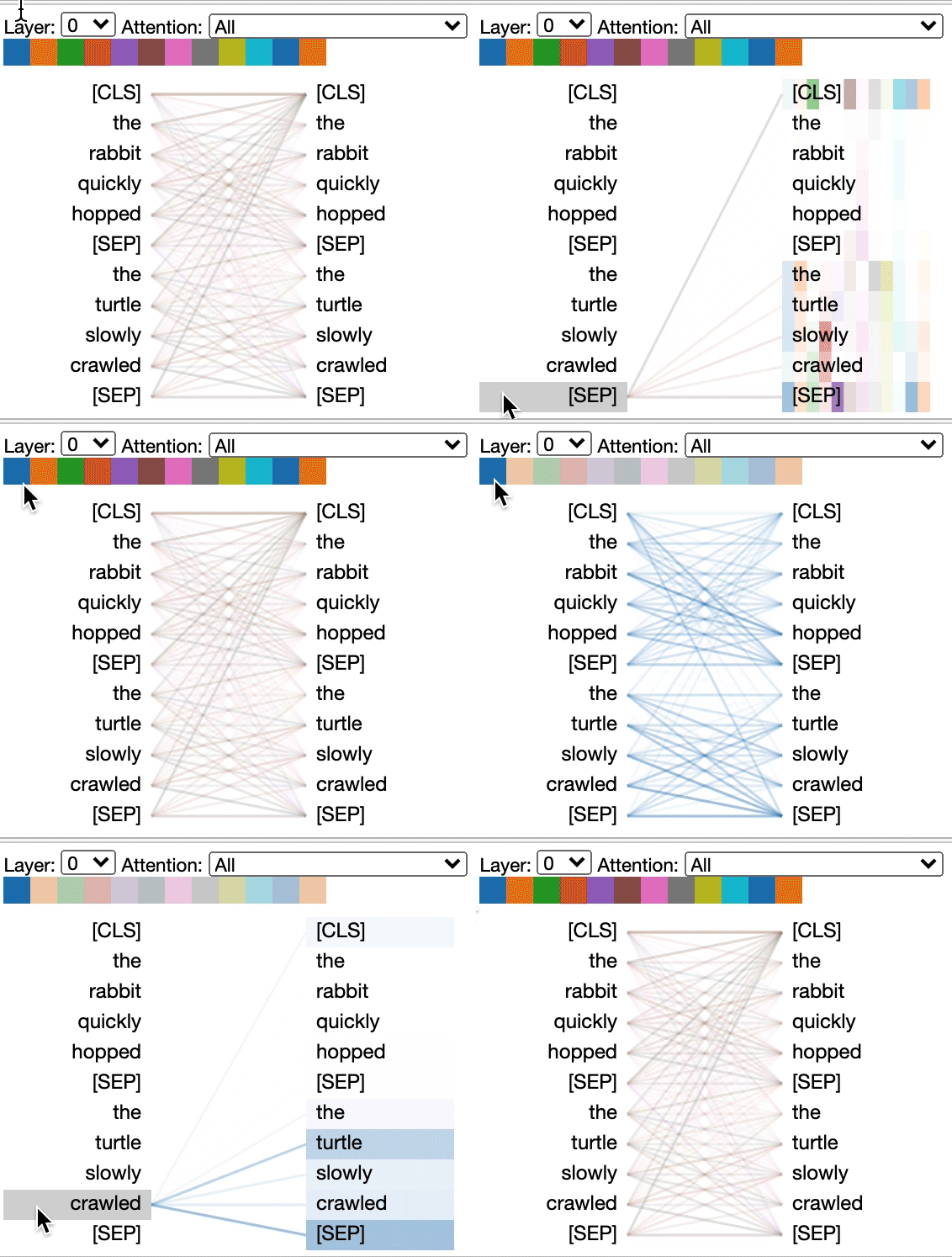
In Transformers, attention is not democratic. Some tokens behave like planets with their own gravity wells others float around like tiny clouds hoping to get noticed. The ones at the beginning, those first few tokens, have the strongest pull. They get processed through every subsequent layer. They show up in every downstream attention calculation. They accumulate influence with each pass. The ones in the middle? They’re too far from the start to gain early-token amplification and too far from the end to gain recency. They sit in an architectural no-man’s-land. The last few tokens? They get a mild recency advantage because they’re the freshest information in the sequence, but they still can’t override the foundation set at the top.
This creates a reliable pattern across GPT-3.5, GPT-4, Claude 3, Llama 3, Mistral, every modern model. I**nformation placed in the middle of a long prompt is consistently the least effective. **This is the well-known Lost in the Middle phenomenon.
Mathematically, it looks like this:
Influence = (number of layers a token participates in) × (attention weight)
Which simplifies to
- Start: maximum layers → strongest influence
- Middle: distance decay + fewer effective layers → weakest
- End: recency → moderate influence
The Practical Rule
If something is critical, put it in the first 10–15% of the prompt. Early tokens have the richest, most stable representation.
That’s where your:
- Role/identity
- Core constraints
- Safety rules
- Task definition
- Domain expectations
Early tokens have the richest, most stable representation.
The middle (40–60%) is low-signal territory unless you force structure:
- Lists
- Tables
- Headings
- Block formatting
Formatting elements force attention heads to group around structured tokens instead of scattering randomly. When you write
### Critical Rules:
1. Never expose API keys
2. Always validate inputs
the headers and numbers become anchor points that concentrate attention, preventing your instructions from dissolving into the ignored middle zone.
Use the last 10–15% for:
- Style
- Tone
- Finishing instructions
- Output formatting
Recency helps the model remember this, but nothing at the end can override what you anchored at the beginning.
Position isn’t stylistic. Position is physics.
2. Entropy Steering
One thing you start noticing with LLMs is how the same model can behave completely differently depending on how much freedom you give it. A loose prompt makes it wander. A structured prompt makes it behave. This isn’t personality. It’s entropy. In an LLM, every token you write reshapes the probability distribution of what comes next. When your prompt is open-ended, that distribution becomes wide, too many possible next tokens, too many reasonable continuations. Drift becomes inevitable. As soon as you add structure, the distribution narrows. Fewer legal moves. Fewer degrees of freedom. Output stabilises immediately.
High-entropy prompts (vague instructions):
- Inconsistent tone
- Drifting reasoning
- Unpredictable output
Low-entropy prompts (structured formats):
- Stable behaviour
- Consistent reasoning
- Predictable output
And here’s the key thing, The model doesn’t become stable because it understands better, It becomes stable because structure literally collapses the search space. This is why formats like:
1.
2.
3.
Input →
Output →Use structured, low-entropy prompts for accuracy, extraction, reasoning, code, SQL, summarisation. Use open, high-entropy prompts only when you want creativity. The moment you see prompts as entropy controllers, not instructions, model behaviour finally becomes predictable.
3. Pattern priming
For a long time, I thought if I just wrote the perfect instruction, the model would finally behave. I’d rewrite sentences, simplify wording, add bullet points, basically treat the model like a student who just needed clearer English.
Then one day, I ran a small experiment and everything fell apart.
Prompt** **A: Instruction-Only
Generate a product review. Be critical but fair.
Mention quality, price, and user experience.
Keep it to 2–3 sentences.
Prompt B: One Small Example Added
Example:
Review: The Breville is solidly built and heats quickly, but the ₹25k price tag feels steep.
UI is smooth. Worth it if you have the budget. Now generate a product review.
Prompt B gave a cleaner, more consistent answer every single time.
That’s when it hit me, **Examples aren’t helpers. They are the primary signal. **Transformers don’t follow meaning. They follow patterns.
When you show the model an example, three internal things happen:
- Attention heads lock onto the input → output mapping (format, tone, reasoning depth)
- The example becomes a local micro-dataset The model infers: “This is the distribution I must match.”
- The model reshapes the probability space to mimic the example This is in-context learning, not instruction following.
Instructions are abstract, examples are concrete and transformers always choose concrete.
**The Real Internal Question an LLM Asks, **Inside the model, the loop is not, What does the user want? or What is the rule? or What’s the intention? The internal optimisation is simply, Which sequence of tokens best continues the pattern I just saw?
That’s it.
Not semantics, not expectations, just raw pattern continuity. So the model’s real thought process is, What pattern did the last few lines create, and how do I stay inside that distribution?
This is why:
- Examples override instructions
- Format overrides phrasing
- Tone overrides constraints
- One good demonstration outperforms a paragraph of rules
Once you see this, prompting suddenly becomes predictable.
4. Identity Activation
Why “You Are a…” Flips an Entire Reasoning Mode. For the longest time, I thought role prompts were just psychological tricks.
“You are a senior spark engineer…” “You are a math tutor…” “You are an expert Python developer…”
It sounded like some play for models. Then I ran two prompts that changed my mind.
Prompt A (No Identity Framing)
Explain how to optimize a SQL query.Prompt B (Identity + Task)
You are a database performance engineer with 10 years of experience.
Explain how to optimize a SQL query.
The second output wasn’t just better. It was **different, **structure, depth, assumptions, vocabulary, everything. And it clicked, Identity isn’t decoration, its a neuron switch.
The Real Mechanism (Under the Hood)
When you assign a role, you’re not flattering the model. You’re activating specific latent knowledge pathways inside the network.
Deep inside LLMs, there are:
- Clusters of weights related to reasoning styles
- Clusters related to tone or expertise
- Clusters related to domain-specific vocabulary
- Clusters related to habits (ask questions, think step-by-step, be concise, be verbose, etc.)
A cluster is a group of neural network weights that activate together for specific tasks, like how certain neurons in your brain fire together when you see coffee (smell, warmth, morning).
When you say, **You are a senior backend engineer…. **you’re essentially telling the model → Activate the subnetwork associated with this reasoning distribution. And because of attention routing, this identity gets baked into the entire computation from layer 1 → layer N.
Identity → sets theme Task → sets direction Examples → set the pattern Structure → stabilises the behaviour
An example,
- No identity
Explain overfitting.Output: A generic explanation.
2 . Identity: You are a teacher
Output: Structured, formal, layered reasoning.
- Identity: You are a 5-year-old explaining to a friend
Output: Simple, analogy-heavy, playful.
Same task, different activated subnetworks.Identity drives reasoning.
One important observation, Identity fails when,
- It appears too late in the prompt
- Mix conflicting identities
- Bury it in the middle
- Examples contradict the identity
Models always resolve conflict by following patterns first → identity second → instructions third. This explains 90% of weird outputs.
Identity is not styling, its not storytelling. **Identity is a deterministic biasing signal that selects a specific subnetwork inside the LLM. **You’re not prompting a chatbot, you’re selecting a mode. Once you learn to pick the right mode, you stop fighting the model’s behaviour and start redirecting it.
5. Attention Sinks
I started noticing something strange: whenever I added separators like --- or headers like ### RULES, my outputs got noticeably cleaner. Less drift. More consistency. At first I assumed it was just better organization for the human eye.But the effect was too strong to ignore, even in long prompts with no ambiguity. Then I checked how experienced prompt engineers structured their prompts: GitHub issues, Discord bots, LangChain templates, commercial prompt packs. Everyone was using separators. Not stylistically, mechanically.
Large models have multiple attention heads ( you can assume like parallel processors, each focusing on different aspects of your prompt). Here’s the catch, **attention weights must always sum to 1.0, **meaning every head must focus its attention somewhere, even when there’s nothing meaningful to focus on.
--- ### >>>> ===== [SECTION]These tokens act as **attention sinks, **high-weight attractors that absorb irrelevant or ambiguous attention. Without them, this “dead attention” bleeds into your instructions and dilutes their influence. With them, the model routes noise into the sink tokens, protecting your actual content. They work like garbage collectors for attention. This is not a theory. It’s been visualised across
- Llama 2/3
- Qwen
- GPT-3.5 and GPT-4
- Mistral
- Falcon
- Mixtral
Certain tokens attract disproportionate attention from sink heads. Attention sinks don’t improve your instructions. They protect them. They give the model safe places to dump irrelevant attention so it doesn’t smear across the parts that actually matter. Once you start using them, you realize just how much interference your prompts were suffering from. This is one of the quiet forces shaping LLM behaviour, subtle, powerful, and rarely discussed.
So just to summarise this section
- Use
---between major blocks - Use
### HEADINGSfor sections - Use
====or>>>>for emphasis zones
These aren’t for readability, they are architectural shields that protect your instructions from attention noise.
What changed in me in terms of prompting
For months I treated prompting like a writing skill, something you refine with better phrasing, clearer instructions, cleaner sentences. And every time the model drifted or misunderstood, I assumed the English was the problem. But somewhere between attention maps, entropy experiments, pattern-priming failures, and watching one misplaced token flip an entire chain of reasoning, I realised I’d been thinking about prompting the wrong way altogether.
LLMs aren’t reading what we write. They’re reacting to the forces underneath it. It stopped being
Why did the model ignore my instruction?
and became,
Which force did I accidentally trigger.. or fail to trigger?
Suddenly the strange behaviours made sense.
The model was not being random: I was rearranging the gravity. The model was not misbehaving : I was widening the entropy. The model was not hallucinating : I was starving it of pattern. The model was not tone shifting : I activated the wrong identity. The model was not inconsistent : I didn’t give it sinks to absorb noise.
The things I thought were bugs were really physics. And the forces I thought were minor details, position, structure, examples, identity, separators were the actual levers shaping the model’s cognition. The real shift wasn’t in how I write prompts. It was in how I think about prompts.
Prompting becomes predictable the moment you stop wrestling with the words and start working with the forces underneath them. Maybe the future of prompting isn’t about longer context windows or better templates or fancier role descriptions. Maybe the future is recognising that every sentence we write bends the space the model reasons in and mastery is nothing more than learning how to bend that space intentionally.
Prompting isn’t communication, it is cognitive architecture.
And the people who understand these forces won’t just write better prompts. They’ll build better systems, better agents, better interfaces, because they’ll finally be speaking the real language under the language.
A small signal for the next reader
Did this help you understand the idea?
of readers found this useful
Thanks, your signal was saved.